


 photos by Tanja Kanazir / Drugo More
︎ CATALOGUE.PDF
Some images outlive their original meaning. They become myth.
As they circulate, they may lose provenance, shift aesthetic form, and even begin to speak for someone, or something else. What erodes is not just meaning, but the conditions that once defined the image and its legibility, defined by framing, context, format, and use.
--------------------------------------------------------------------------------------------
Image Remains begins with the Angel of History, a figure that originates from Angelus Novus, a 1920 monoprint by Paul Klee, later theorized and renamed by Walter Benjamin in his 1940 Theses on the Philosophy of History.
Benjamin describes the figure of the Angel as a creature that refuses historicism: the then-governing, linear account of events written from the position of those in power. The Angel would like to stay, awaken the dead, and make whole what has been smashed. But the storm we call progress has caught her wings with violence, propelling her into an unseen future.
Today, history, truth, and reality are aggressively reframed by those in power as they write and rewrite memory in real time, making Benjamin’s Angel painfully current.
For sixteen years, I have used the Angel as a protagonist in my work (since the Collapse of PAL, in 2010).
I have always felt that her philosophy of history is closely related to Resolution Studies - the study of compromises in image processing. Resolution Studies operates from a desire to recover what has been lost while being carried forward by processes of continuous re-rendering.
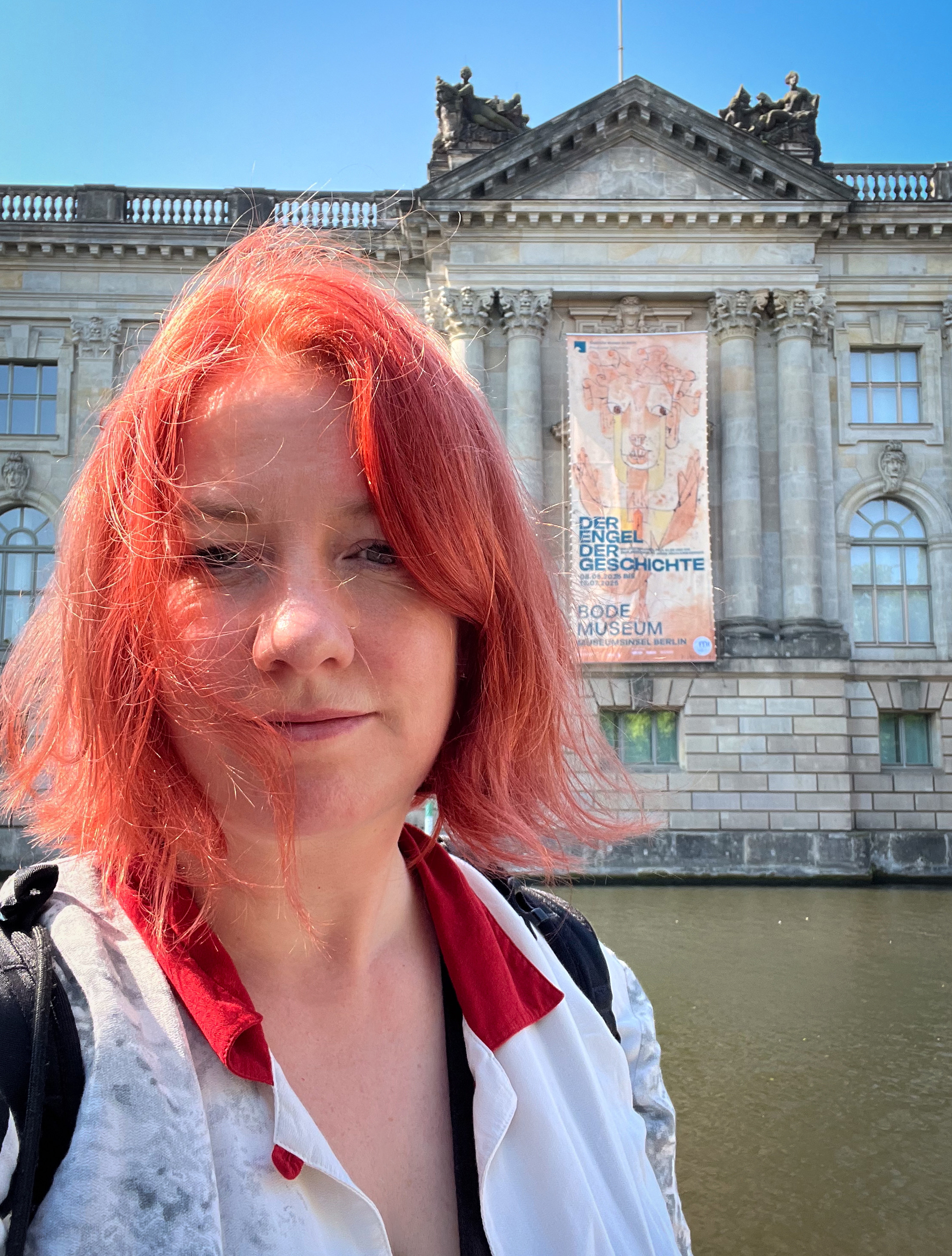
In 2025, I saw the original monoprint when it was exhibited in Berlin. The encounter was surprising.
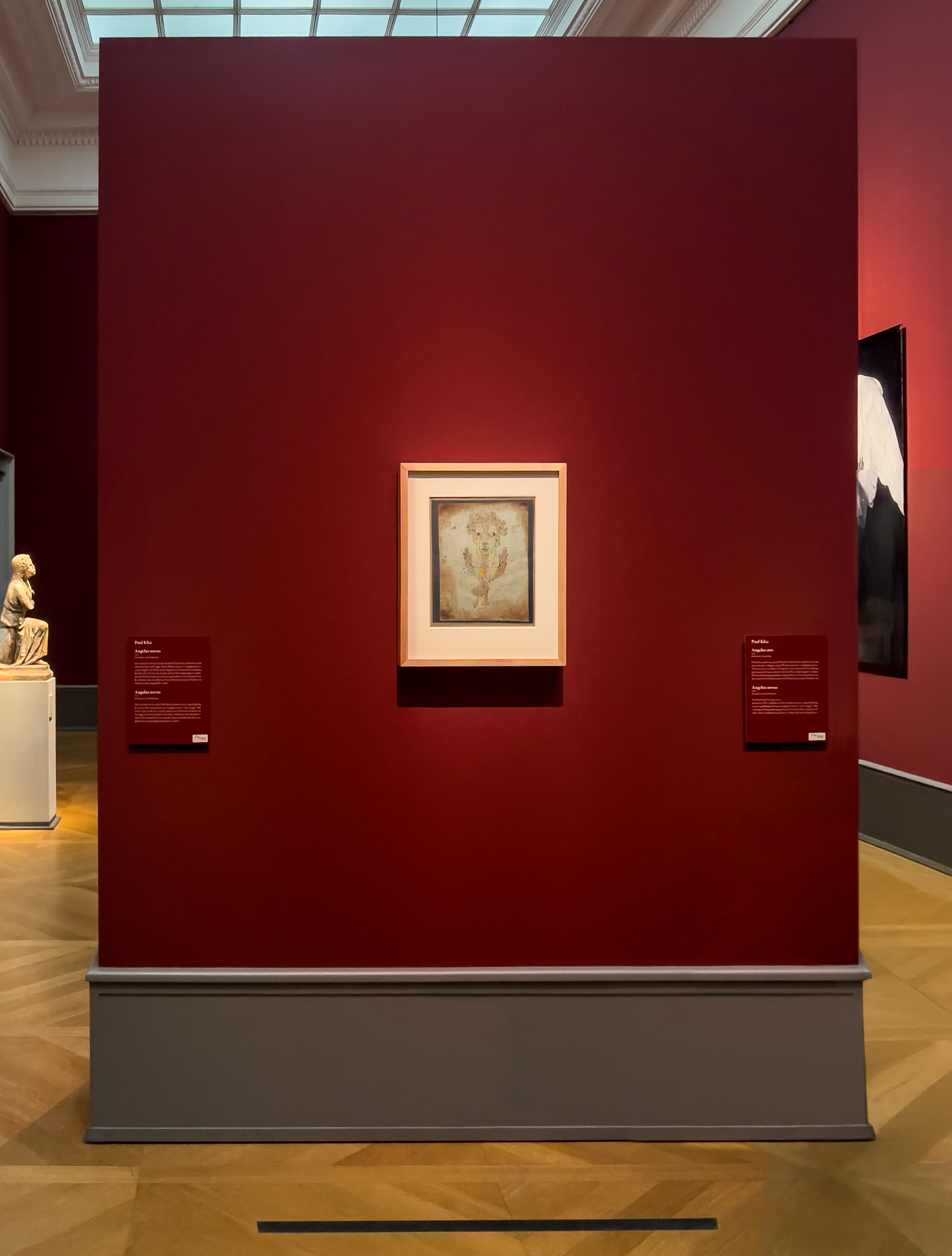
The work was mounted on an impressive red wall, while the catalog presented the loan of the work from the Israel Museum as a celebration of sixty years of diplomatic relations between Germany and Israel. More recently, when Angelus Novus’ flight to New York was delayed because of the USA’s war on Iran, a facsimile stood in for the original for two months. The figure Benjamin had mobilized against official histories and narratives of progress had become co-opted by state diplomacy, stuck in transport conditions, and subsumed by institutional substitution.
What is left of the Angel when her image is redeployed on a museum wall and in catalog language to narrate continuity and advancement? What remains of her image when she is stripped of her refusal of historicism and instead becomes a symbol of geo-national politics? Image Remains begins from this transformation: from monoprint to facsimile, from historical witness to geopolitical symbol, from image to infrastructure.
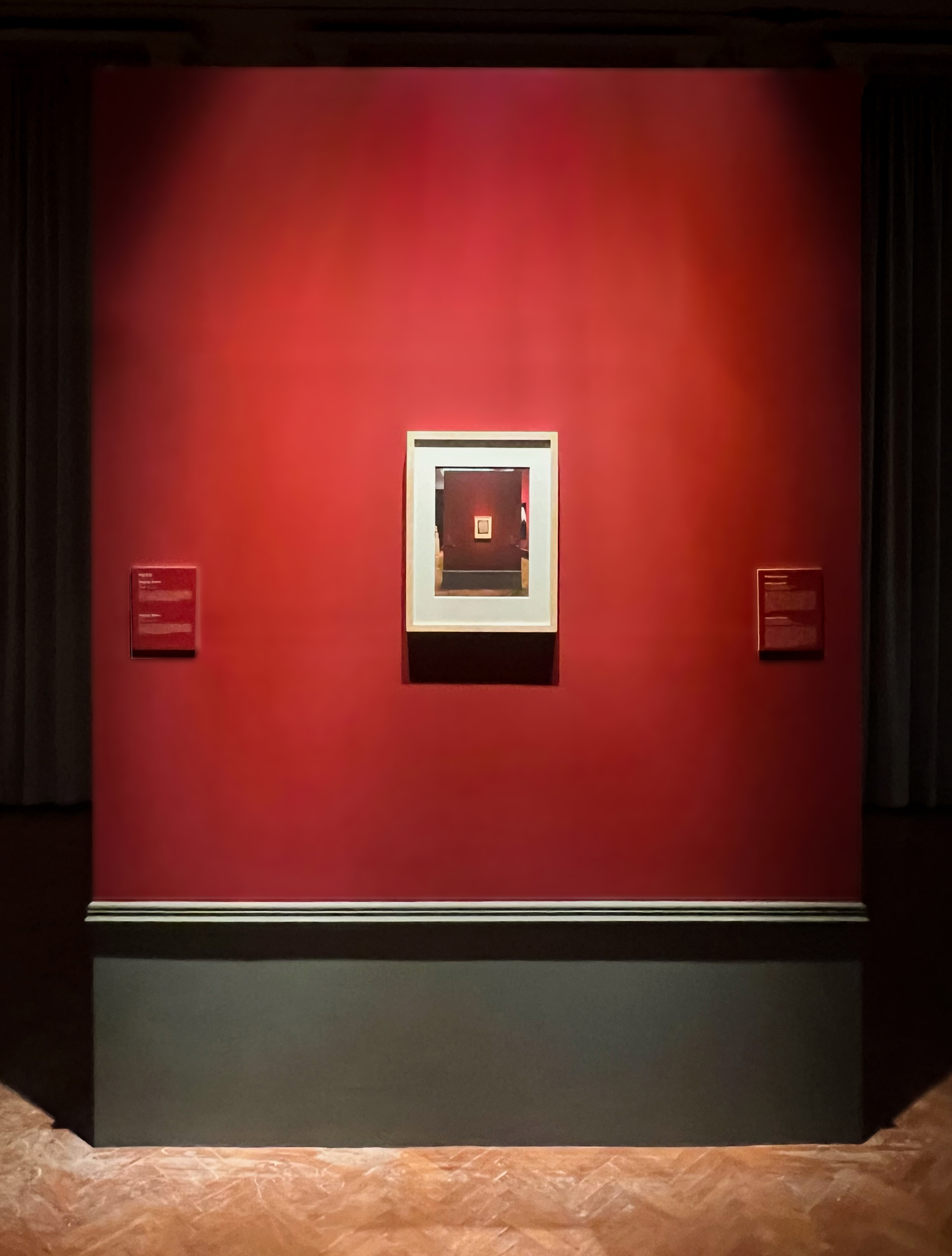
At the front of the installation, I emulate the red wall I encountered in Berlin, now making it part of the Angel rather than part of the exhibition architecture. Behind it, a three-tier video installation follows the Angel as she attempts to escape the conditions that render her visibility, and to reclaim agency over her own resolution.
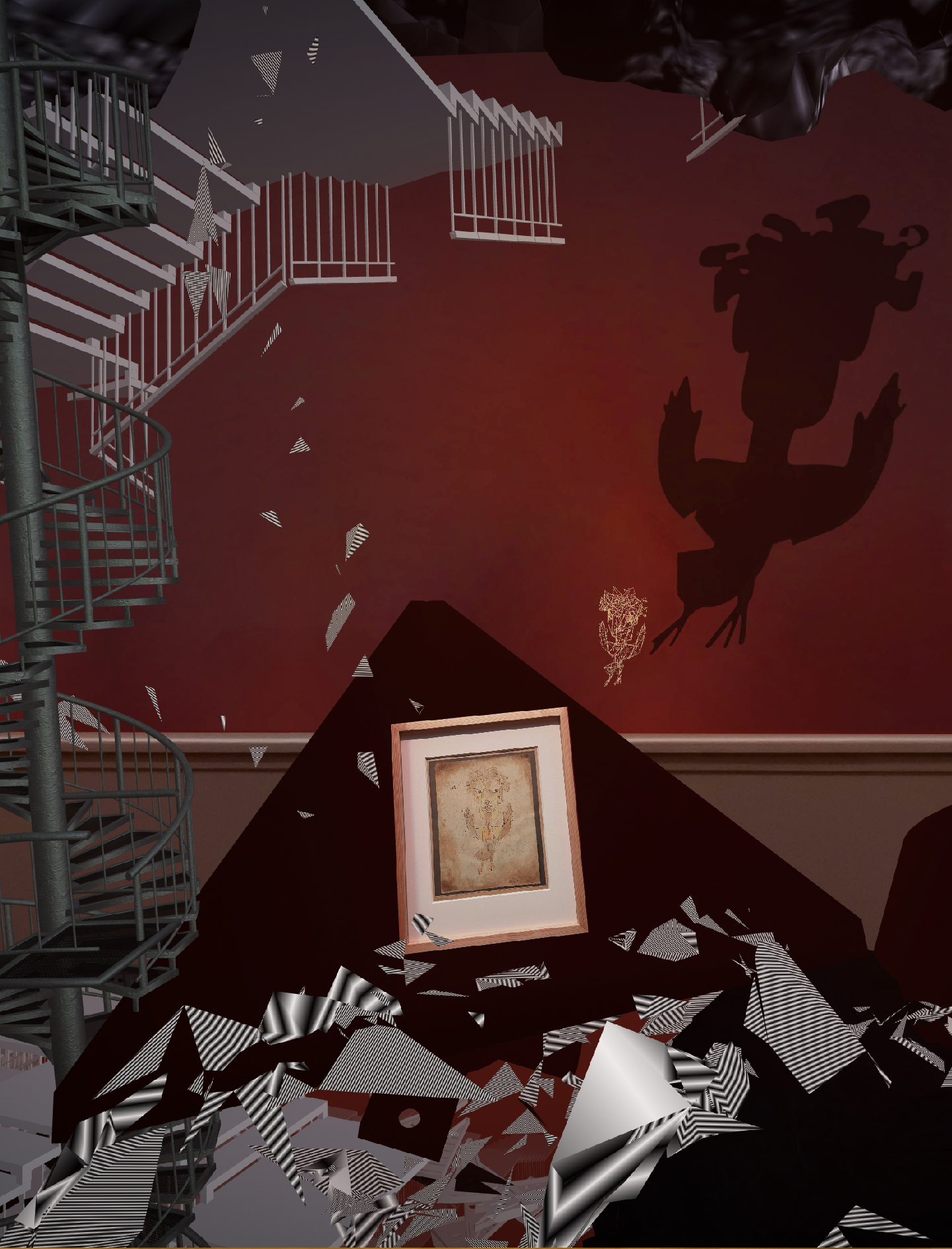
Across the triptych, the Angel is classified, scheduled, and transcoded by protocols that decide how, where, when, and in what form she can appear. She moves through different ecologies of contemporary image processing, from copied facsimile to networked and finally synthetic image. The exhibition asks what refusal can look like when an image becomes a governed, non-static object, moving through networks, update cycles, and systems that privilege machine readability.
--------------------------------------------------------------------------------------------
- Solo show at DRUGO MORE, Rijeka, Croatia
15 January - 5 February, 2026.
- Installation at the NTT InterCommunication Center [ICC], Tokyo, as Part of ICC Annual 2026: What Is Left, What Remains, and What We Take On.
June 20–November 8, 2026.
Some images outlive their original meaning. They become myth.
As they circulate, they may lose provenance, shift aesthetic form, and even begin to speak for someone, or something else. What erodes is not just meaning, but the conditions that once defined the image and its legibility, defined by framing, context, format, and use.
--------------------------------------------------------------------------------------------
Image Remains begins with the Angel of History, a figure that originates from Angelus Novus, a 1920 monoprint by Paul Klee, later theorized and renamed by Walter Benjamin in his 1940 Theses on the Philosophy of History.
Benjamin describes the figure of the Angel as a creature that refuses historicism: the then-governing, linear account of events written from the position of those in power. The Angel would like to stay, awaken the dead, and make whole what has been smashed. But the storm we call progress has caught her wings with violence, propelling her into an unseen future.
Today, history, truth, and reality are aggressively reframed by those in power as they write and rewrite memory in real time, making Benjamin’s Angel painfully current.
For sixteen years, I have used the Angel as a protagonist in my work (since the Collapse of PAL, in 2010).
I have always felt that her philosophy of history is closely related to Resolution Studies - the study of compromises in image processing. Resolution Studies operates from a desire to recover what has been lost while being carried forward by processes of continuous re-rendering.
In 2025, I saw the original monoprint when it was exhibited in Berlin. The encounter was surprising.
The work was mounted on an impressive red wall, while the catalog presented the loan of the work from the Israel Museum as a celebration of sixty years of diplomatic relations between Germany and Israel. More recently, when Angelus Novus’ flight to New York was delayed because of the USA’s war on Iran, a facsimile stood in for the original for two months. The figure Benjamin had mobilized against official histories and narratives of progress had become co-opted by state diplomacy, stuck in transport conditions, and subsumed by institutional substitution.
What is left of the Angel when her image is redeployed on a museum wall and in catalog language to narrate continuity and advancement? What remains of her image when she is stripped of her refusal of historicism and instead becomes a symbol of geo-national politics? Image Remains begins from this transformation: from monoprint to facsimile, from historical witness to geopolitical symbol, from image to infrastructure.
At the front of the installation, I emulate the red wall I encountered in Berlin, now making it part of the Angel rather than part of the exhibition architecture. Behind it, a three-tier video installation follows the Angel as she attempts to escape the conditions that render her visibility, and to reclaim agency over her own resolution.
Across the triptych, the Angel is classified, scheduled, and transcoded by protocols that decide how, where, when, and in what form she can appear. She moves through different ecologies of contemporary image processing, from copied facsimile to networked and finally synthetic image. The exhibition asks what refusal can look like when an image becomes a governed, non-static object, moving through networks, update cycles, and systems that privilege machine readability.
--------------------------------------------------------------------------------------------
- Solo show at DRUGO MORE, Rijeka, Croatia
15 January - 5 February, 2026.
- Installation at the NTT InterCommunication Center [ICC], Tokyo, as Part of ICC Annual 2026: What Is Left, What Remains, and What We Take On.
June 20–November 8, 2026.
ANGEL’S RETURN
The Angel traverses a century of upgrades. As artifacts mark her wings, generation loss washes over her. She becomes a shadow, a myth, bound to the standards and algorithms of a specific time and place.
Her mission remains: she refuses a singular resolution of history as written by those in power.
HOROLOGY
As the Angel slips out of institutional custody, she persists as multimodal copies in circulation.
In the network and on the platform, engineers schedule her appearance through administered moments that depend on buffers, attention cycles, and surveillance.
REFRACTIONS
After a century of observing the ruins of the past, the Angel embarks on a mission to learn from a Cyclops foresight.
Once she enters its timeline, optical vision fails and orientation collapses. Due to a lack of protocol, all she captures is noise: machine-to-machine encoded vectors and render objects that refuse legibility.


Since the Collapse of PAL (2010), the Angel of History has been a protagonist in my work.
In 2014, my research pivoted to Resolution Studies, where I trace how standards foreclose certain modes of operation. Resolution standards and their infrastructures decide what signals count as compatible and what gets filtered out, what becomes too costly, and what is erased, compressed, or labeled as noise.As a result of that pivot, in my artwork, the Angel explores new signals and infrastructures, not to nostalgically mourn their obsolescence but to trace the hidden compromises inside image technologies.
I knew that Benjamin’s Angel is inseparable from Paul Klee’s 1920 monoprint Angelus Novus, which Benjamin acquired in 1921 and kept with him ever since. Benjamin’s philosophy of the Angel was inspired by that print. But during my many years of working with the Angel, I had never seen Paul Klee’s original Angelus Novus in person: the print is considered ‘fragile,’ and is usually kept safe in the Israel Museum’s archives. However, during the summer of 2025, the Angel was on display at the Bode Museum in Berlin, celebrated as “the return of Berlin’s Angel.” When, in a stroke of luck, I heard about this, I booked the first train out and went on my way to meet her.
In the early hours, before the museum was even open, I sat in front of it, waiting. It was me and a handful of other people. Soon enough, it became clear that some of us specifically came for the Angel. We didn’t speak, but we did walk in an awkward procession, up along the winding stairs following the signs that brought us to her, stopping for no other artifact.
When I finally locked eyes with her, the experience touched me more than I expected.
But I am still not sure what part of the Angel I met then.
What I remember most is not the print, but the staging.
The Angel was mounted on a specially erected, giant burgundy-red wall, supported by oversized grey skirting that functioned almost as a second frame. A security guard stood next to the wall at all times, and the alarm was triggered easily (I accidentally set it off a few times).
I think I may remember the scene more than the print itself.
The 2025 exhibition catalog intensified this institutional reframing. Jörg Völlnagel presents the loan of the print as a hopeful return linked to the 60th anniversary of diplomatic relations between Germany and Israel and argues for an optimistic “looking ahead,” contrasting it to what he calls Benjamin’s “history-pessimistic” interpretation.
This time, however, one could optimistically push back against Benjamin’s history-pessimistic readings and say that looking ahead is worthwhile too. Today, on the 80th anniversary of Germany’s capitulation in the Second World War on 8 May 1945, and also (this should not go unmentioned) on the 60th anniversary of the establishment of diplomatic relations between Israel and the Federal Republic of Germany on 12 May 1965, the kabbalistic angel travels as a symbol of hope to a city that was once its own, from which it was driven out, and to which it now returns triumphantly and with a Janus face. The angel returns to show us that progress should not exist without knowledge of the past, that remembrance should not exist without striving for a better future, but also that blind belief in progress, paired with historical amnesia, leads to ruin. The angel arrives at the right time. Its journey from Jerusalem to Berlin is a powerful symbol of warning and of friendship at once, even if it is “only” about justice and not reconciliation.
- Excerpt and translation to English from the essay “Wenn Engel reisen …” by Jörg Völlnagel from the Bode Museum exhibition catalog. Der Engel der Geschichte : Walter Benjamin, Paul Klee und die Berliner Engel 80 Jahre nach Kriegsende. Heidelberg: arthistoricum.net, 2025.
What troubles me is not the act of remembrance: remembrance is an integral part of the Angel. What I take issue with is the rewriting of the Angel’s function into a symbol of diplomatic friendship, staged as a moral lesson at a timed commemorative moment.
The violence lies in the transformation of an object of active remembrance of a multitude of voices and a criticism of Historicism into a symbol for the celebration and national geopolitics. In the Bode Museum context, the Angel returns as a diplomatic image; a managed symbol that can be installed, captioned, and timed, while signaling moral closure that excludes ongoing violence and repression. This illustrates how state power can stage justice as concluded, even as the unresolved legacies of the Second World War continue to produce violence both locally and elsewhere, including in Palestine.
The framing of the Angel in the Bode Museum is a form of what I would describe as operational historicism: a mode of historiography where meaning is not argued but executed. When institutions produce historical truth through actions such as scheduling, display, captions, press, and catalog output, or via methods of speed and repetition, they attempt to control circulation: the artifact performs designated closure at a preselected moment. This type of operational historicism not only produces history as a timed, managed output, but also has a second consequence: what does not conform to the dominant template becomes harder to present and retrieve, and easier to exclude from the record entirely. Not because it vanishes, but because the conditions don’t give it space to exist.
This is why, when I locked eyes with Angelus Novus, I did not see the object that inspired Benjamin to write about the Angel of History. I met a reframed object that the institution projected a history written by dominating nations onto.
This realization sits inside this exhibition, Image Remains, where I try to negotiate what happens when the image that was meant to hold space for the voices and signals of those who are actively suppressed is overwritten. What happens when an image that already lives in circulation is pulled back into a controlled frame: can the Angel refuse?
The Angel remains an image, but what remains of that image? Custody, framing, captioning, scheduling, compression, editing, meme-ing, transcoding, degradation — all of it washes over her. The image that remains is not a neutral remainder; it is what survives protocol.
The image becomes myth because it refuses this imposition of closure, even when it is framed and captioned.

A Klee painting named Angelus Novus shows an angel looking as though he is about to move away from something he is fixedly contemplating. His eyes are staring, his mouth is open, his wings are spread. This is how one pictures the angel of history. His face is turned toward the past. Where we perceive a chain of events, he sees one single catastrophe which keeps piling wreckage upon wreckage and hurls it in front of his feet. The angel would like to stay, awaken the dead, and make whole what has been smashed. But a storm is blowing from Paradise; it has got caught in his wings with such violence that the angel can no longer close them. The storm irresistibly propels him into the future to which his back is turned, while the pile of debris before him grows skyward. This storm is what we call progress.
- Walter Benjamin. Thesis IX (1939 - 1940, published posthumously in 1942)
In 1920, the Swiss-born German painter Paul Klee produced a figure using an oil transfer drawing with watercolor, resulting in what is later described as a monoprint. The process produced lines that look both handmade and mechanically displaced, and they left a strange mix of diagrammatic creature-ness.
He named the figure Angelus Novus.
The German philosopher Walter Benjamin saw the Angel at a major Klee exhibition in Munich in 2021 and bought it for 1,000 marks. Accounts describe how the Angel travelled with him from Berlin when he had to flee from the nazis, and how its material survival became inseparable from Benjamin’s life and political catastrophe: Benjamin fled Germany in 1933, after the Nazis came to power, and settled in Paris. As the regime stripped German Jews of their citizenship, Benjamin became stateless. As a result, he was arrested by the French authorities and incarcerated for three months in a prison camp near Nevers, in central Burgundy.
After his release, he returned to Paris. In January 1940, while Europe collapsed around him, he drafted “On the Concept of History”, later published as Theses on the Philosophy of History. In this text, Benjamin criticises historicism, the governing method of history production that presents the past as a continuous narrative of progress. Benjamin mailed a copy of his theses to Hannah Arendt, who later passed it on to Theodor W. Adorno. At that moment, both the manuscript and the Angel existed in transit: neither belonged to a place. Each dependent on care and transmission, to remain in future.
As the German army pushed the French forces back, Benjamin and his sister fled Paris for Lourdes, leaving just a day before German troops entered the capital with orders to arrest him. In August 1940, he obtained a travel visa to the United States, negotiated by Max Horkheimer. He planned his journey through Spain and neutral Portugal.
Benjamin crossed the French–Spanish border and arrived in the coastal town of Portbou on 25 September 1940. There, the Franco regime cancelled all transit visas and ordered the Spanish police to return the Jewish refugee group he had joined to be deported back to France the next day. Expecting capture, Benjamin took an overdose of morphine that night.
Before fleeing Paris, Benjamin had left the print of the Angel for safekeeping with Georges Bataille, who hid it at the Bibliothèque Nationale. After the war, the work passed via Theodor W. Adorno to Gershom Scholem. After Scholem’s death, his wife left the print to the collection of the Israel Museum in Jerusalem, where it remains in the archive and is only shown occasionally.