
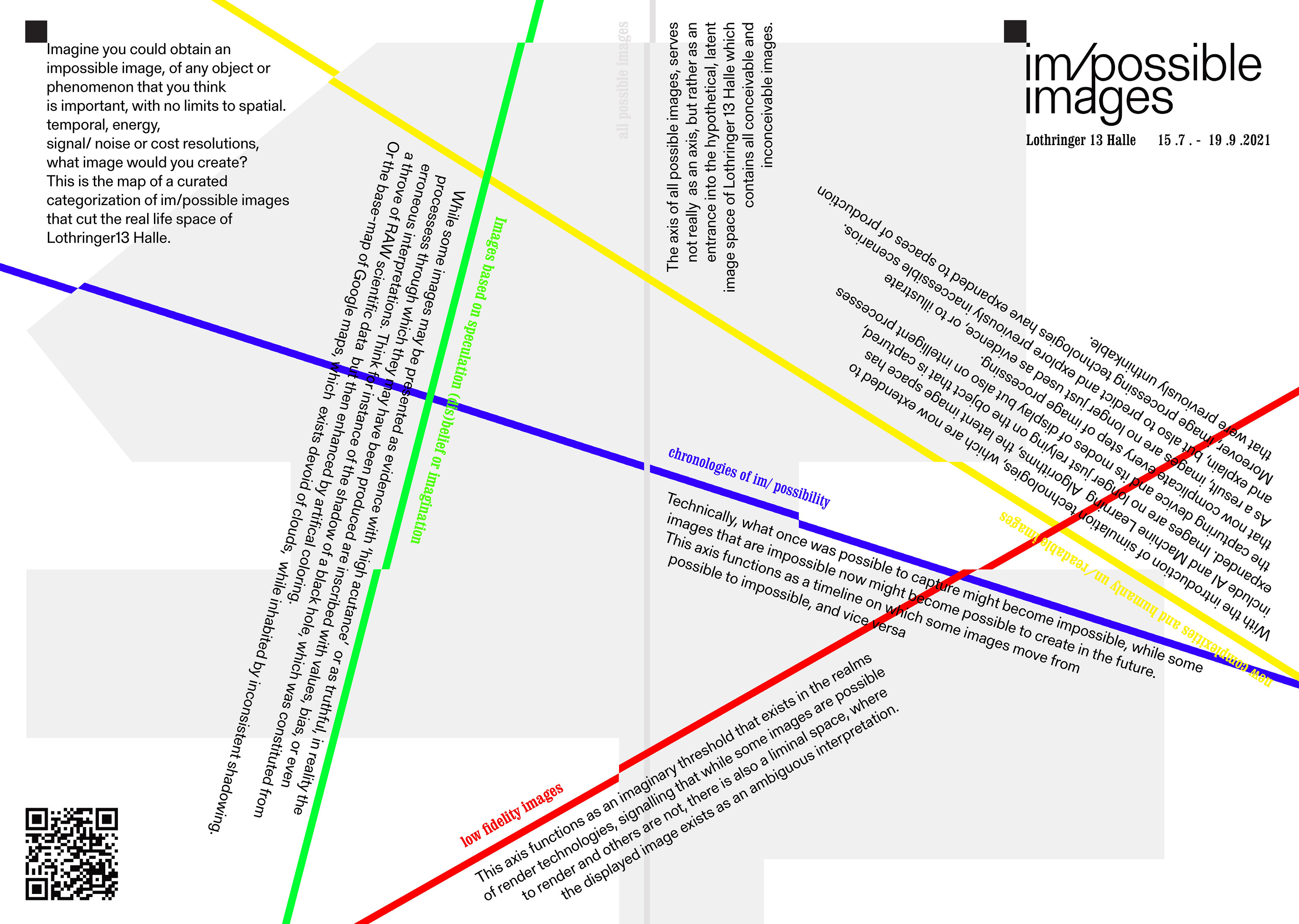
In the summer of 2021, I was invited by Luzi Gross to conceptualize and curate a physical exhibition of im/possible images at the Lothringer 13 Halle (München). The exhibition was an opportunity to transform the Lothringer into a real space actualisation of the virtual BLOB. In the space of the Lothringer five categories of im/possibility were introduced as parameters or axes of affordances. These axes materialized as architectural elements that physically cut through the rooms of the exhibition halls. But we stopped short of calling the Lothringer a BLOB, instead calling the exhibition the latent space of im/possible images.
In analogue photography, the latent image space exists when photosensitive material has been exposed, but has not gone through a process of development (yet). It is the space that has been touched by light, but that is not showing trace evidence (in the form of an image). The im /possible images show used the term ‘latent image’ as an expanded concept, referring to a hypothetical space that exists before exposure and therefore can still develop every imaginable or unimaginable image.
The main premise of im/possible images is that once any action or decision in the procedure of image processing is initiated, a render parameter is chosen. Following this decision, the parameter operates as a metaphoric cut through the space of everything that can be rendered, dividing it up into images that remain possible, and images that, as a consequence of the decision, are impossible. Effectively, every render setting realizes particular images, while also compromising and complicating others.
In preparation for the show at Lothringer, I went back to my collection of im/possible images.
But this time, I did this not to collect images to show, but rather lifted out certain categories I wanted to illustrate via work based in artistic research (as opposed to the mostly scientific illustrations featured in the BLOB).
Alex Adriaansens Residency, thanks to director Michel van Dartel and curator Florian Weigl.

works:
︎Rosa Menkman, BLOB of Im/Possible Images, 3D word, 2021.
The white axis, the axis of all possible images, starts outside the gallery and serves as the entrance into the hypothetical latent image space of Lothringer 13 Halle. The axis features two works; the BLOB of im/possible images and All Possible Images [True Color, Full HD] (2021). The latter, All Possible Images, is an entirely new, commissioned work by Fabian Heller. In All Possible Images, Heller explores the absolute maximal, finite number of possible renders an HD computer screen can display. Given enough time (and screens to render on), any sequence of pixels - or ways to fill up an HD display - will eventually occur somewhere at some moment in the world. However, the number of images that a FullHD screen can render is immense. It stretches beyond understanding at a human scale - and ushers in a scenario reminiscent of Borges’ Library of Babel and Émile Borels infinite monkey theorem. In an essay in the im/possible images reader Heller therefore concludes that All Possible Images comes with its own impossibilities.
works:
︎UCNV, Supercritical, Video installation, 2019.
︎Peter Edwards, Nova Drone, Interactive installation, 2012.
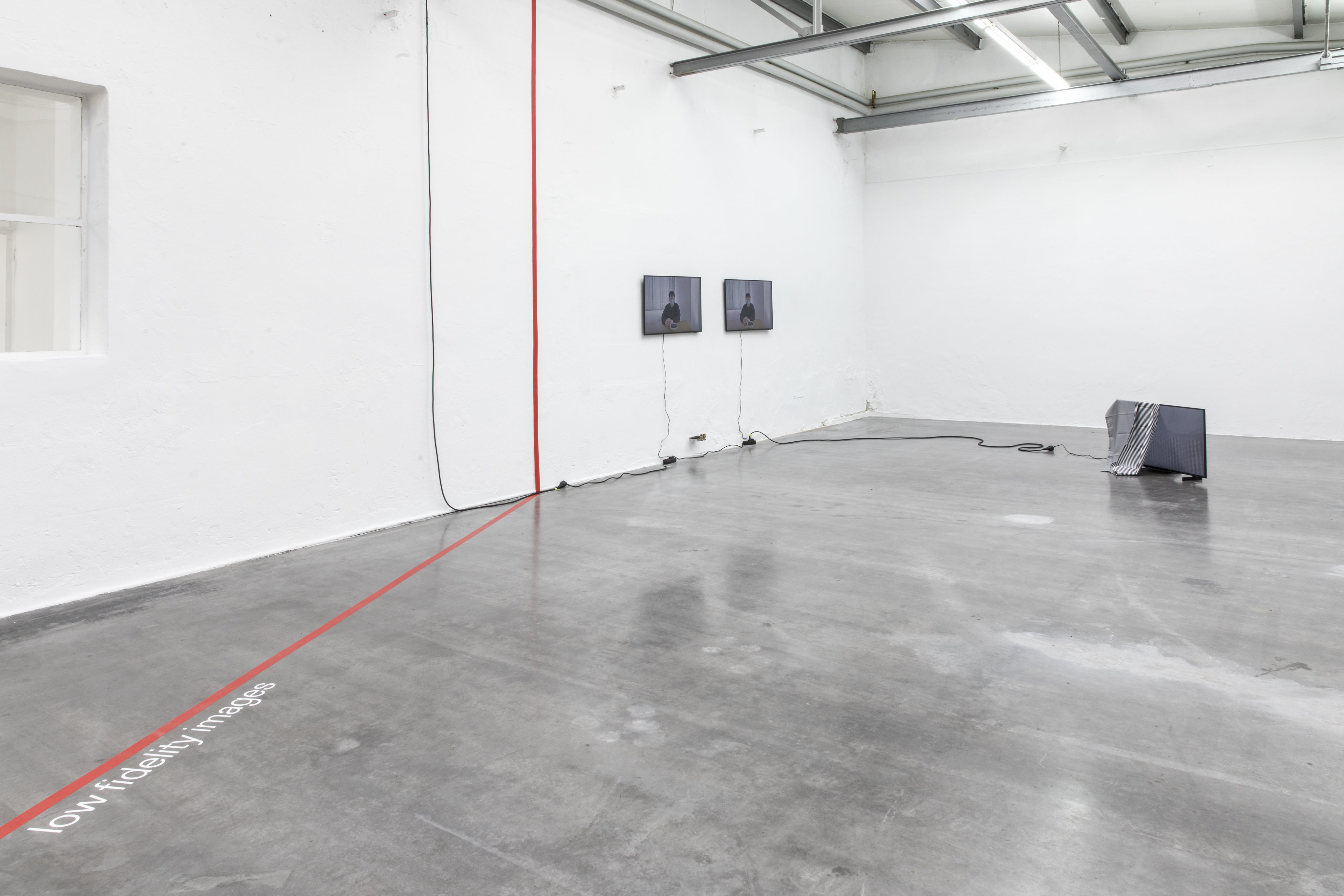
30 meters onwards, the white axis intersects with a red axis named the axis of low fidelity images. This red axis functions as an abstract threshold that exists in the realms of digital rendering technologies, beyond the simple binaries otherwise used to understand whether an image can or can not be rendered and features works by UCNV and Peter Edwards.
Images can be amalgamated rather than consolidated. This means that while image data might be static, the final image render is entirely dependent on the discrete steps of the (lofi) image render pipeline. The works exhibited along this red axis illustrate this. They are examples of images existing as non-static formations, or objects of ambiguous technical interpretation, that explore how technological affordances relate to medium specificity, limitation and erroneous consolidation. For instance, Edwards audio visual synthesizer, the Nova Drone, centers around a LED pulsating at high frequency, translated as image-information by the CCD chip (light capturing chip) that exists in most cell phones. Due to the mis-match in frequency between the light pulse of the LED in the Nova Drone and the speed at which the chip of the phone camera collects and writes away the light, a questionable interpretation appears in the memory - the photo roll - of the phone. Whereas Edwards shows how a mismatch in time resolution by our devices can resolve into beautiful, but erroneous, representations, UCNV illustrates how mechanics play out at the level of pixel resolution. His work Supercritical, also represented in an essay in this reader, demonstrates how changes in quantitative pixel resolution result in ambiguous, fluid data morphing. A mechanism that is taken one step further in Daniel Temkin’s contribution to this reader, a how-to guide titled “Unprintables”, which is a manual for creative quantitative pixel resolution mis-use.

works:
︎Susan Schuppli, Can the sun lie? Video, 2014–2015
︎Sasha Engelmann & Sophie Dyer, Open Weather, Installation & Workshop, 2020-2021
︎Rosa Menkman, Whiteout, video (15 min.), 2020
︎Quote by Ingrid Burrington "forever noon on a cloudless day"
︎NASA basemap of Earth.
A green axis titled images based on speculation, dis/belief or imagination runs almost perpendicular to the red axis. The works installed along this axis show the complex dynamic in images that are presented as evidentiary, truthful or scientific. They illustrate that all processes of image sourcing inevitably inscribe them with values, bias or even faulty interpretations.
One evocative example in the exhibition is the basemap of planet Earth. A map completely devoid of clouds, inhabited by inconsistent shadowing and a blanketing noon time zone - or as Ingrid Burrington rightfully states: on the basemap of planet Earth, it is “forever noon on a cloudless day.” In this reader there are three texts accompanying the green axis. First, a reprint of Susan Schuppli’s formidable essay Can the Sun Lie (2014-2015), in which she shares a striking account of how a system of belief can thwart scientific inquiry. Secondly, the manual for the open weather workshop that was used during the im/possible summer school at the Lothringer. With the help of this manual, one can listen to the NOAA satellites and decode their radio transmission to create a local weather report that goes beyond values of precipitation and temperature, but highlights under-represented values like smog, light or other environmental conditions (of pollution). The axis concludes with “Whiteout”, in which I tell the story of an exhausting mountain hike during a snowstorm and the experience of the loss of my physical sensations - leading to an inability to see, hear, or orient myself. While the spatial dimensions are at first seemingly wiped out, an experience of oversaturation starts to offer the environment to me in new, different imagery ways.

documentation:
︎Röntgen, Röntgen photo, print, 1896
︎NASA Voyager / Carl Sagan, Pale blue dot, 1990
︎Medipix, spectroscopic X-ray 2018

works:
︎Alan Warburton, RGB FAQ, Video essay (27:38 min), 2020
︎Memo Akten, Learning to See: Gloomy Sunday, HD Video (3:02 min), 2017
︎Rosa Menkman, Shredded Hologram Rose (4:30 min) 2021
Finally, the yellow axis presents new complexities and humanly un/readable images. This axis focuses on new layers of image processing, added since the advent of AI image generation. During the exhibition in the Lothringer Alan Warburtons video essay RGBFAQ, of which the text is reproduced in this reader, was seen in the basement. In RGBFAQ, Warburton asks what the computational image is? Completing the axis are Memo Aktens’ Learning to See (2017) and The Shredded Hologram Rose (Rosa Menkman, 2021).